Fluxer is now hosted in the EU, and it's faster and more stable than before. Read how we moved

Fluxer is now hosted in the EU

fluxer.com is moving to hardware we own in two colocation data centres in Sweden, and on the way it runs in Germany and stores its data in the EU.

The Fluxer logo inside the ring of twelve gold stars from the EU flag

Fluxer is a free, open source Discord alternative for friends and communities, with text chat, voice and video calls and screen sharing, and you can also host it yourself. It's built and run by Fluxer Platform AB, an independent Swedish company.

Summary

  • fluxer.com has been hosted in the EU since 22 November 2026.
  • It's on its way to our own servers in Lund and Malmö in southern Sweden.
  • It's more stable, and in a normal weekday hour in Limburg the median API request took 44 ms, down from about 150 ms before the move.
  • We rebuilt how we monitor fluxer.com and how we get alerted.
  • We rebuilt the gateway your apps connect to.
  • We wrote new docs for running Fluxer on your own hardware.

fluxer.com runs on dedicated servers in the beautiful city of Limburg, Germany, and the data it stores is kept in the European Union. Limburg is a stop on the way to hardware we own, in two colocation data centres in Skåne in southern Sweden. Even this stopover is far more stable than our old cloud machines were, and fluxer.com will stay in Limburg while we rack the last pieces of hardware in Sweden.

Limburg Cathedral with its seven spires on a rock above the Lahn on a summer evening, with trees and the Erbacher Hof along the riverbank and the cathedral reflected in the water
Limburg Cathedral above the river Lahn at dusk. Can't you just feel the GDPR in the air? Our servers are somewhere less scenic. Photo © Steffen Schmitz (Carschten) / Wikimedia Commons / CC BY-SA 4.0

Your data is stored in the EU

The GDPR protects all of your data on fluxer.com. Your account, messages, communities, files and attachments are stored in data centres in Germany, and encrypted backups are also kept in the EU. Our hosting providers in Germany are European companies, and none of them is a US company or part of a US group.

The US CLOUD Act lets US authorities order a company under US jurisdiction to disclose data it controls, wherever in the world that data is stored. The same applies to a data centre in Frankfurt if a US company runs it. In June 2025, Microsoft France told a French Senate inquiry under oath that it couldn't guarantee French citizens' data would never go to US authorities without the agreement of France.

Fluxer has no US parent company and no US subsidiary. A US court could still claim jurisdiction over us, but an order sent directly to us can't be enforced in the EU unless a treaty backs it, and we point US authorities to the treaty route through Sweden.

Audio and video in calls are encrypted in transit and aren't stored, and calls can go through voice servers outside the EU so that they connect near the people in them. I'm working on the new voice system. It's built to fix many problems you reported with calls, and every call on it will be end-to-end encrypted. Once it's out, the voice servers can't access anything you say or show in a call, wherever in the world they are.

Our own edge servers run around the world, including in the EU, and your app or browser connects to the nearest one. We operate them ourselves on dedicated machines we rent, and no outside CDN company is involved.

The edge servers keep copies of our public web pages and app files and of media such as profile pictures, emoji and attachments to make Fluxer load faster, and they never store the text of your messages. An attachment is only sent to someone with a valid link to it, and copies are cleared soon after the original is deleted.

Payments and push notifications also go through Stripe, app stores and push notification services, and those companies handle them outside the EU.

Why we left the cloud
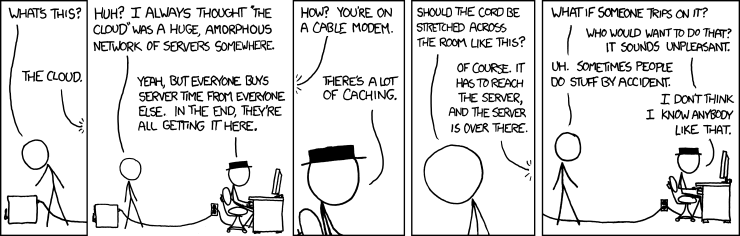
A five-panel xkcd comic. Someone asks what the box on the floor is and hears that it's the cloud. They thought the cloud was a huge network of servers somewhere, and are told that everyone buys server time from everyone else and in the end it all ends up here. When they ask how that works on a cable modem, the owner says there's a lot of caching. The cord to the server is stretched across the room, and when they ask what happens if someone trips on it, the owner says he doesn't know anybody like that.
"The Cloud" by Randall Munroe, xkcd 908, CC BY-NC 2.5.

When Fluxer started, Cloudflare served our website files and uploads, and in the spring of 2026 we moved them to a European CDN provider. On 12 September, it forwarded DMCA notices about a few uploaded files and gave us 48 hours to remove them.

We removed the files within minutes, but the provider suspended our whole DNS zone within 30 minutes of receiving the notices. fluxer.com was down for most of the two hours it took us to move our DNS to another provider.

Issues with accessing our apps or loading images
Our CDN provider suspended our entire DNS zone within 30 minutes of receiving DMCA takedowns, despite giving us a 48-hour deadline to delete the content from the platform.

The provider closed our account with no way to appeal, and its support team gave us at least five explanations that didn't agree with each other.

A provider that treats a platform as the author of everything its users upload can take a service offline whenever it likes. That was the last straw for outside CDNs, and since then we've run our own edge servers around the world.

On 23 October, our old cloud provider ran scheduled maintenance on the system that managed our Kubernetes cluster, and all seven of our machines were marked as not ready at once. None of our apps crashed or restarted, but nothing could send traffic to them, and fluxer.com showed errors for six minutes on a Friday evening.

Before the move, fluxer.com ran on virtual machines that shared their CPUs with other customers, and when someone else got busy, Fluxer got slower. On 16–17 November, 37 to 50 per cent of the CPU time on the machines that ran our API went to other customers, which Linux reports as steal time. The median API request took 400 to 490 ms instead of about 150 ms, and one request in 20 took more than 2 seconds.

Nobody else uses the CPUs in our servers in Limburg. In a normal weekday hour on 23 November, the median API request took 44 ms, 95 per cent of requests finished within 200 ms, and steal time on our servers stayed at zero.

In Limburg we rent dedicated servers from our host and run everything on them ourselves, Kubernetes included. Our host provides the machines, the data centre and its network, and we pay for those machines every month.

How we monitor fluxer.com

Along with the move, we rebuilt how we monitor fluxer.com. We collect metrics from the API, the gateway, our databases, storage and Kubernetes, and we keep them for 35 days. Logs from all of our services go into one place where we can search them, and our 55 dashboards are kept in Git along with the rest of our setup.

We get paged by phone when, for example, a database node goes down, storage fills up fast, backups are late or the number of connected sessions drops sharply. A check outside our servers pages us if the alerting itself stops working.

API requests, media, uploads, web pages, gateway connections and joining voice calls each have a target for how many requests must succeed and how fast. We get paged by phone when errors use up one of those targets too quickly.

Right after the move finished in the early hours of 22 November 2026, new DM calls didn't start for about 30 minutes and most push notifications didn't arrive for about an hour. As of 26 November, fluxer.com hasn't had an outage since then.

On 23 November, 7,293 new accounts were made on fluxer.com, 2.4 times the daily average earlier in November. The next day, 19,230 new accounts were made, the most fluxer.com has ever had in one day and more than six times that average.

From April to November Accounts on fluxer.com by the date they were created, from 1 April 2026 to 26 November 2026, with one point per day. Each day on the chart runs from midnight to midnight UTC.
0200k400k600k800kAprMayJunJulAugSepOctNovBig refactor and open source mobile appsAugust waveNew desktop appOperator PassBiggest day so far1 April 2026: 185,529 accounts (+1,266 that day)2 April 2026: 186,770 accounts (+1,241 that day)3 April 2026: 187,900 accounts (+1,130 that day)4 April 2026: 189,031 accounts (+1,131 that day)5 April 2026: 190,120 accounts (+1,089 that day)6 April 2026: 191,318 accounts (+1,198 that day)7 April 2026: 192,431 accounts (+1,113 that day)8 April 2026: 195,771 accounts (+3,340 that day)9 April 2026: 197,714 accounts (+1,943 that day)10 April 2026: 200,586 accounts (+2,872 that day)11 April 2026: 202,487 accounts (+1,901 that day)12 April 2026: 205,778 accounts (+3,291 that day)13 April 2026: 207,535 accounts (+1,757 that day)14 April 2026: 209,247 accounts (+1,712 that day)15 April 2026: 210,257 accounts (+1,010 that day)16 April 2026: 211,198 accounts (+941 that day)17 April 2026: 212,245 accounts (+1,047 that day)18 April 2026: 213,400 accounts (+1,155 that day)19 April 2026: 214,277 accounts (+877 that day)20 April 2026: 215,114 accounts (+837 that day)21 April 2026: 215,927 accounts (+813 that day)22 April 2026: 216,686 accounts (+759 that day)23 April 2026: 217,492 accounts (+806 that day)24 April 2026: 218,259 accounts (+767 that day)25 April 2026: 219,128 accounts (+869 that day)26 April 2026: 220,011 accounts (+883 that day)27 April 2026: 220,743 accounts (+732 that day)28 April 2026: 221,559 accounts (+816 that day)29 April 2026: 222,362 accounts (+803 that day)30 April 2026: 223,057 accounts (+695 that day)1 May 2026: 223,793 accounts (+736 that day)2 May 2026: 224,421 accounts (+628 that day)3 May 2026: 225,138 accounts (+717 that day)4 May 2026: 225,691 accounts (+553 that day)5 May 2026: 226,220 accounts (+529 that day)6 May 2026: 226,794 accounts (+574 that day)7 May 2026: 227,348 accounts (+554 that day)8 May 2026: 230,689 accounts (+3,341 that day)9 May 2026: 231,342 accounts (+653 that day)10 May 2026: 231,949 accounts (+607 that day)11 May 2026: 232,432 accounts (+483 that day)12 May 2026: 232,966 accounts (+534 that day)13 May 2026: 233,477 accounts (+511 that day)14 May 2026: 233,958 accounts (+481 that day)15 May 2026: 234,442 accounts (+484 that day)16 May 2026: 234,993 accounts (+551 that day)17 May 2026: 235,382 accounts (+389 that day)18 May 2026: 235,837 accounts (+455 that day)19 May 2026: 236,347 accounts (+510 that day)20 May 2026: 236,820 accounts (+473 that day)21 May 2026: 237,278 accounts (+458 that day)22 May 2026: 237,689 accounts (+411 that day)23 May 2026: 238,203 accounts (+514 that day)24 May 2026: 238,798 accounts (+595 that day)25 May 2026: 239,304 accounts (+506 that day)26 May 2026: 239,783 accounts (+479 that day)27 May 2026: 240,186 accounts (+403 that day)28 May 2026: 240,633 accounts (+447 that day)29 May 2026: 241,162 accounts (+529 that day)30 May 2026: 241,654 accounts (+492 that day)31 May 2026: 242,166 accounts (+512 that day)1 June 2026: 242,763 accounts (+597 that day)2 June 2026: 243,255 accounts (+492 that day)3 June 2026: 243,766 accounts (+511 that day)4 June 2026: 244,222 accounts (+456 that day)5 June 2026: 244,690 accounts (+468 that day)6 June 2026: 245,127 accounts (+437 that day)7 June 2026: 245,550 accounts (+423 that day)8 June 2026: 245,979 accounts (+429 that day)9 June 2026: 246,439 accounts (+460 that day)10 June 2026: 246,873 accounts (+434 that day)11 June 2026: 247,261 accounts (+388 that day)12 June 2026: 247,652 accounts (+391 that day)13 June 2026: 248,151 accounts (+499 that day)14 June 2026: 248,573 accounts (+422 that day)15 June 2026: 249,062 accounts (+489 that day)16 June 2026: 249,668 accounts (+606 that day)17 June 2026: 250,165 accounts (+497 that day)18 June 2026: 250,602 accounts (+437 that day)19 June 2026: 251,085 accounts (+483 that day)20 June 2026: 251,596 accounts (+511 that day)21 June 2026: 252,083 accounts (+487 that day)22 June 2026: 252,581 accounts (+498 that day)23 June 2026: 253,054 accounts (+473 that day)24 June 2026: 253,459 accounts (+405 that day)25 June 2026: 253,859 accounts (+400 that day)26 June 2026: 254,263 accounts (+404 that day)27 June 2026: 254,662 accounts (+399 that day)28 June 2026: 255,154 accounts (+492 that day)29 June 2026: 256,129 accounts (+975 that day)30 June 2026: 256,836 accounts (+707 that day)1 July 2026: 257,479 accounts (+643 that day)2 July 2026: 257,960 accounts (+481 that day)3 July 2026: 258,933 accounts (+973 that day)4 July 2026: 260,719 accounts (+1,786 that day)5 July 2026: 262,103 accounts (+1,384 that day)6 July 2026: 263,715 accounts (+1,612 that day)7 July 2026: 264,595 accounts (+880 that day)8 July 2026: 265,316 accounts (+721 that day)9 July 2026: 266,294 accounts (+978 that day)10 July 2026: 267,073 accounts (+779 that day)11 July 2026: 267,702 accounts (+629 that day)12 July 2026: 268,456 accounts (+754 that day)13 July 2026: 269,200 accounts (+744 that day)14 July 2026: 269,858 accounts (+658 that day)15 July 2026: 270,454 accounts (+596 that day)16 July 2026: 271,060 accounts (+606 that day)17 July 2026: 271,630 accounts (+570 that day)18 July 2026: 272,104 accounts (+474 that day)19 July 2026: 272,627 accounts (+523 that day)20 July 2026: 273,146 accounts (+519 that day)21 July 2026: 273,657 accounts (+511 that day)22 July 2026: 274,142 accounts (+485 that day)23 July 2026: 274,605 accounts (+463 that day)24 July 2026: 275,058 accounts (+453 that day)25 July 2026: 275,582 accounts (+524 that day)26 July 2026: 276,103 accounts (+521 that day)27 July 2026: 276,658 accounts (+555 that day)28 July 2026: 277,235 accounts (+577 that day)29 July 2026: 277,773 accounts (+538 that day)30 July 2026: 278,243 accounts (+470 that day)31 July 2026: 278,711 accounts (+468 that day)1 August 2026: 279,179 accounts (+468 that day)2 August 2026: 279,748 accounts (+569 that day)3 August 2026: 280,298 accounts (+550 that day)4 August 2026: 280,969 accounts (+671 that day)5 August 2026: 281,564 accounts (+595 that day)6 August 2026: 282,086 accounts (+522 that day)7 August 2026: 283,289 accounts (+1,203 that day)8 August 2026: 284,092 accounts (+803 that day)9 August 2026: 285,093 accounts (+1,001 that day)10 August 2026: 287,705 accounts (+2,612 that day)11 August 2026: 288,517 accounts (+812 that day)12 August 2026: 289,555 accounts (+1,038 that day)13 August 2026: 291,082 accounts (+1,527 that day)14 August 2026: 292,303 accounts (+1,221 that day)15 August 2026: 293,155 accounts (+852 that day)16 August 2026: 293,998 accounts (+843 that day)17 August 2026: 305,385 accounts (+11,387 that day)18 August 2026: 319,739 accounts (+14,354 that day)19 August 2026: 330,055 accounts (+10,316 that day)20 August 2026: 338,526 accounts (+8,471 that day)21 August 2026: 345,778 accounts (+7,252 that day)22 August 2026: 354,296 accounts (+8,518 that day)23 August 2026: 361,076 accounts (+6,780 that day)24 August 2026: 365,251 accounts (+4,175 that day)25 August 2026: 368,892 accounts (+3,641 that day)26 August 2026: 372,310 accounts (+3,418 that day)27 August 2026: 375,594 accounts (+3,284 that day)28 August 2026: 378,467 accounts (+2,873 that day)29 August 2026: 382,240 accounts (+3,773 that day)30 August 2026: 385,778 accounts (+3,538 that day)31 August 2026: 387,934 accounts (+2,156 that day)1 September 2026: 390,047 accounts (+2,113 that day)2 September 2026: 392,176 accounts (+2,129 that day)3 September 2026: 394,036 accounts (+1,860 that day)4 September 2026: 396,325 accounts (+2,289 that day)5 September 2026: 399,485 accounts (+3,160 that day)6 September 2026: 402,470 accounts (+2,985 that day)7 September 2026: 405,366 accounts (+2,896 that day)8 September 2026: 407,293 accounts (+1,927 that day)9 September 2026: 409,086 accounts (+1,793 that day)10 September 2026: 410,869 accounts (+1,783 that day)11 September 2026: 413,006 accounts (+2,137 that day)12 September 2026: 414,792 accounts (+1,786 that day)13 September 2026: 416,666 accounts (+1,874 that day)14 September 2026: 418,104 accounts (+1,438 that day)15 September 2026: 420,110 accounts (+2,006 that day)16 September 2026: 421,596 accounts (+1,486 that day)17 September 2026: 423,173 accounts (+1,577 that day)18 September 2026: 424,422 accounts (+1,249 that day)19 September 2026: 426,243 accounts (+1,821 that day)20 September 2026: 428,363 accounts (+2,120 that day)21 September 2026: 429,894 accounts (+1,531 that day)22 September 2026: 431,500 accounts (+1,606 that day)23 September 2026: 435,725 accounts (+4,225 that day)24 September 2026: 440,203 accounts (+4,478 that day)25 September 2026: 443,094 accounts (+2,891 that day)26 September 2026: 446,106 accounts (+3,012 that day)27 September 2026: 449,169 accounts (+3,063 that day)28 September 2026: 451,536 accounts (+2,367 that day)29 September 2026: 453,720 accounts (+2,184 that day)30 September 2026: 455,749 accounts (+2,029 that day)1 October 2026: 458,065 accounts (+2,316 that day)2 October 2026: 460,154 accounts (+2,089 that day)3 October 2026: 462,726 accounts (+2,572 that day)4 October 2026: 465,221 accounts (+2,495 that day)5 October 2026: 467,324 accounts (+2,103 that day)6 October 2026: 469,585 accounts (+2,261 that day)7 October 2026: 471,591 accounts (+2,006 that day)8 October 2026: 473,906 accounts (+2,315 that day)9 October 2026: 476,119 accounts (+2,213 that day)10 October 2026: 478,712 accounts (+2,593 that day)11 October 2026: 481,462 accounts (+2,750 that day)12 October 2026: 484,348 accounts (+2,886 that day)13 October 2026: 486,701 accounts (+2,353 that day)14 October 2026: 489,747 accounts (+3,046 that day)15 October 2026: 491,949 accounts (+2,202 that day)16 October 2026: 494,269 accounts (+2,320 that day)17 October 2026: 496,740 accounts (+2,471 that day)18 October 2026: 499,435 accounts (+2,695 that day)19 October 2026: 501,562 accounts (+2,127 that day)20 October 2026: 503,727 accounts (+2,165 that day)21 October 2026: 505,741 accounts (+2,014 that day)22 October 2026: 507,958 accounts (+2,217 that day)23 October 2026: 510,243 accounts (+2,285 that day)24 October 2026: 512,782 accounts (+2,539 that day)25 October 2026: 516,006 accounts (+3,224 that day)26 October 2026: 518,933 accounts (+2,927 that day)27 October 2026: 522,101 accounts (+3,168 that day)28 October 2026: 525,575 accounts (+3,474 that day)29 October 2026: 529,073 accounts (+3,498 that day)30 October 2026: 532,445 accounts (+3,372 that day)31 October 2026: 536,844 accounts (+4,399 that day)1 November 2026: 540,529 accounts (+3,685 that day)2 November 2026: 544,957 accounts (+4,428 that day)3 November 2026: 547,914 accounts (+2,957 that day)4 November 2026: 550,793 accounts (+2,879 that day)5 November 2026: 553,747 accounts (+2,954 that day)6 November 2026: 556,514 accounts (+2,767 that day)7 November 2026: 560,141 accounts (+3,627 that day)8 November 2026: 563,629 accounts (+3,488 that day)9 November 2026: 566,392 accounts (+2,763 that day)10 November 2026: 569,229 accounts (+2,837 that day)11 November 2026: 571,845 accounts (+2,616 that day)12 November 2026: 574,232 accounts (+2,387 that day)13 November 2026: 576,854 accounts (+2,622 that day)14 November 2026: 580,125 accounts (+3,271 that day)15 November 2026: 583,542 accounts (+3,417 that day)16 November 2026: 586,322 accounts (+2,780 that day)17 November 2026: 589,036 accounts (+2,714 that day)18 November 2026: 592,199 accounts (+3,163 that day)19 November 2026: 594,869 accounts (+2,670 that day)20 November 2026: 597,759 accounts (+2,890 that day)21 November 2026: 600,853 accounts (+3,094 that day)22 November 2026: 604,114 accounts (+3,261 that day)23 November 2026: 611,407 accounts (+7,293 that day)24 November 2026: 630,637 accounts (+19,230 that day)25 November 2026: 639,073 accounts (+8,436 that day)26 November 2026: 646,566 accounts (+7,493 that day)0200k400k600k800kAprMayJunJulAugSepOctNovBig refactor and open source mobile appsAugust waveNew desktop appOperator PassBiggest day so far0200k400k600k800kAprMayJunJulAugSepOctNovBig refactor and open source mobile appsAugust waveNew desktop appOperator PassBiggest day so far
Data for From April to November
From April to November
Period endingAccountsAdded in period
30 April 2026223,057+38,794
31 May 2026242,166+19,109
30 June 2026256,836+14,670
31 July 2026278,711+21,875
31 August 2026387,934+109,223
30 September 2026455,749+67,815
31 October 2026536,844+81,095
26 November 2026646,566+109,722

fluxer.com runs on four dedicated servers, each with 24 CPU cores and 256 GB of memory, and every message is stored on three of them. We'll keep adding to our monitoring as we move to our own hardware in Skåne.

Our own servers in Skåne

In Skåne we're moving into colocation. With colocation you own your servers, and a data centre rents you only the space for them, power, cooling and a connection to the internet. We bought the servers, network switches and disks ourselves, and everything in our rack belongs to us. We set it all up and run it ourselves.
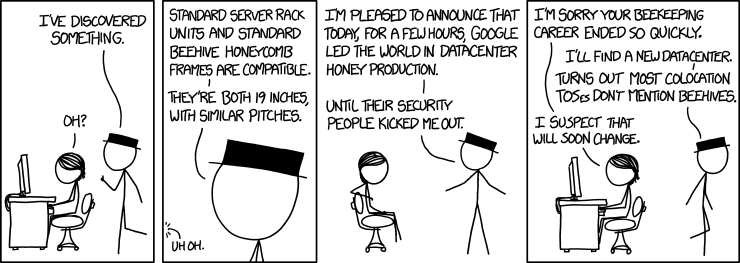
A four-panel xkcd comic. A man in a black hat tells a woman at her desk that standard server rack units and standard beehive honeycomb frames are both 19 inches wide. He announces that for a few hours Google led the world in datacentre honey production, until its security people kicked him out. When she says she's sorry his beekeeping career ended so quickly, he says he'll find a new datacentre, because most colocation terms of service don't mention beehives.
"Rack Unit" by Randall Munroe, xkcd 1439, CC BY-NC 2.5.

We have two sites. DC1 in Lund will run fluxer.com, and DC2 in Malmö will keep a backup copy of fluxer.com's data in a separate building in another city.

From Limburg to Lund, fluxer.com moves about 680 km north.
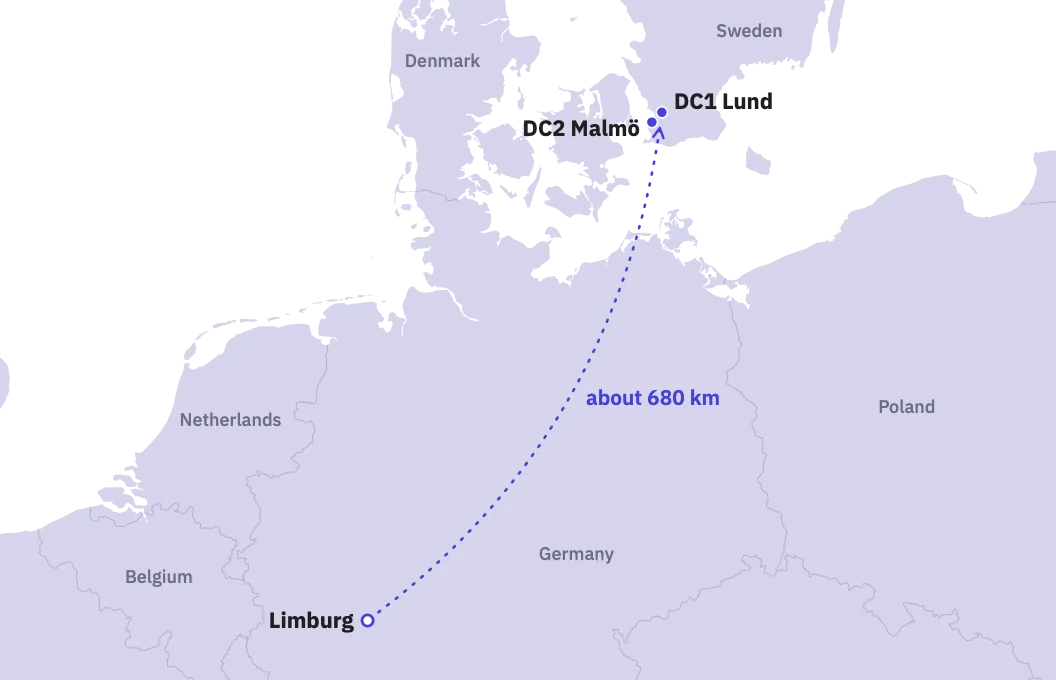
A map of the move from Limburg an der Lahn in Germany to southern Sweden. A dotted line runs about 680 km from Limburg, across northern Germany and the Baltic Sea, to DC1 in Lund. DC2 in Malmö is just south-west of Lund.
The move from Limburg to DC1 in Lund, with DC2 in Malmö next to it. Map data from Natural Earth.

When you rent a server, you pay every month for a machine the host owns, with the host's margin on top. Once we've bought a server, we pay only for its rack space, power and network, and over the years that costs us much less than renting the same machines, even after paying for the hardware up front.

Owning the hardware also saves us from the problems we had with rented cloud machines. The slow API requests and the six-minute outage came from machines we shared with other customers and from maintenance we had no say in. In Skåne, nobody else runs anything on our servers and we decide when they get maintenance, while the data centre looks after the building, power, cooling and network.

Fluxer also has its own autonomous system number, AS199386, and the routers that connect our rack in Lund to the internet are our own machines. We've signed the colocation contract and bought the servers, and we expect to move by the end of 2026, once all of the hardware in Lund and Malmö is set up and tested.

A new gateway in Gleam

The gateway is the part of Fluxer that your apps keep a connection open to, and it sends you new messages, presence, member lists and call events as they happen. It has run on Erlang/OTP and the BEAM virtual machine since the start and still does, but the code has moved from Erlang to Gleam, a typed language that compiles to Erlang.

I wrote a transpiler that converted the Erlang gateway into Gleam code that behaves exactly like the old one, and then I rewrote it all into idiomatic Gleam. Apps, bots and other software talk to the gateway in exactly the same way as before.

Permissions, member lists and other parts that have to be fast are in Rust. The gateway can check a permission in under a microsecond, and a member list of 50,000 people takes a few MB of memory. At about 21:50 CET on 22 November, with about 26,600 live sessions, the whole gateway used about 3.3 CPU cores and 31 GiB of memory.

How a message gets to everyone

A message you send in a community passes through our API and then the gateway before it shows up in the apps of everyone who can see the channel.
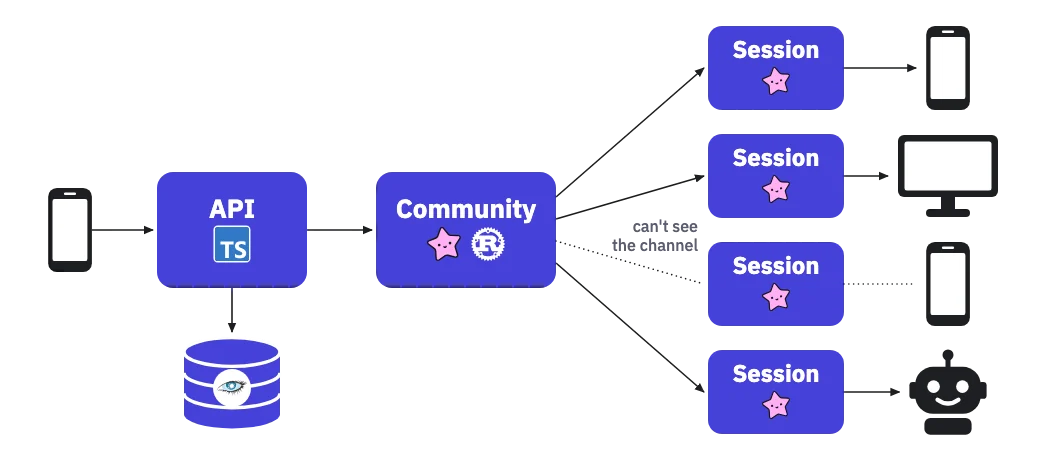
How a message gets to everyone. A phone sends the message to the API, written in TypeScript, which saves it in Cassandra. The API passes it to the community's process in the gateway, written in Gleam with permissions in Rust. The community fans the message out to four sessions, and each session sends it to its device, a phone, a desktop, another phone and a bot. The line to the third session is dotted because that member can't see the channel, so their session and phone don't get the message.
How a message gets from your app to everyone else in a community.
  1. Your app sends the message to our API.
  2. The API checks that you're allowed to post in that channel, and then it saves the message in Cassandra, the database that keeps your messages.
  3. The API passes the message to the gateway, where one process for the community works out which of its members can see the channel.
  4. That process sends the message to the sessions of those members, and each session sends it over the WebSocket connection to that person's app.
  5. The gateway also works out who gets a push notification for the message, and our push service sends it through Apple's, Google's or the browser's push service to every device where that person has turned on notifications.

This Gleam function in the gateway works out which sessions get an event in a channel, such as a new message. It keeps the sessions of members who can view the channel, and in_audience asks the Rust permission code who they are.

fn channel_recipients(
  state: GuildState,
  event_name: String,
  data: JsonTree,
  channel_int: Int,
  candidates: List(Entry),
) -> #(GuildState, List(Entry)) {
  case id.channel_id(channel_int), need(event_name, data) {
    Ok(channel_id), Ok(wanted) -> {
      in_audience(state, channel_id, wanted, candidates)
    }
    _, _ -> #(state, [])
  }
}

Freezing time during a rollout

The gateway is split into roles, such as sessions and communities, and each role runs as many copies, called pods. When we merge a change, Argo CD applies it, and Argo Rollouts replaces the pods of each role a few at a time. The rollout stops by itself if the number of connected sessions drops or a handover fails.

Each pod that is replaced hands what it runs, such as communities or sessions, to pods of the same role that stay up, and then it shuts down. A community first copies its state to the new pod while it keeps running on the old pod as before.
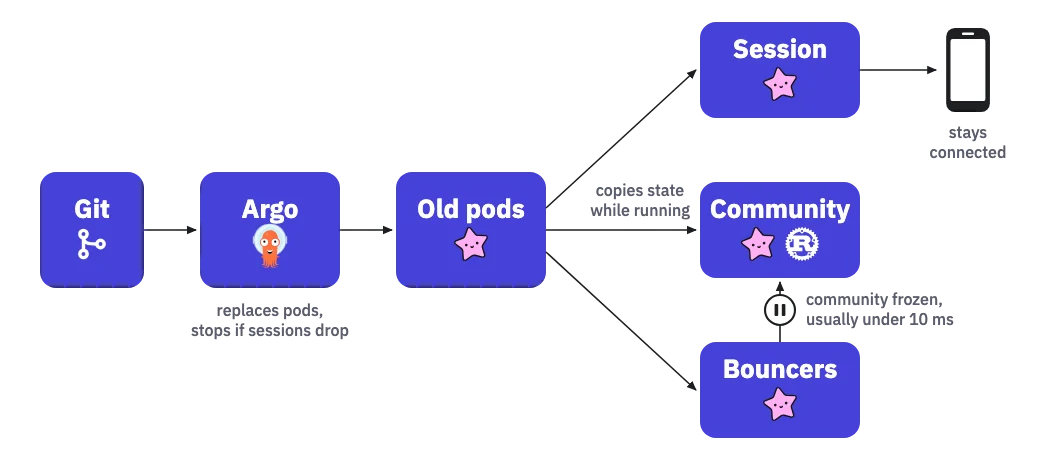
How a change to the gateway rolls out. A merged change in Git goes to Argo CD, and Argo Rollouts replaces the gateway's pods and stops if the number of sessions drops. An old pod copies its community's state to a new pod while the community keeps running. The community is then frozen, usually for under 10 ms, while the bouncers keep its new events and the last small change and hand them to the new pod. A session moves to another pod and the phone stays connected.
How a change rolls out, and how a community and a session move to other pods.

Then the gateway freezes time for that community. New events wait in order at the bouncers, three small pods that keep track of which pod runs each community and session, until the new pod takes over and replays them. In tests the freeze lasted under 10 ms for a typical community. If a freeze goes past 2 seconds, the move is cancelled, and the community thaws and keeps running on the old pod instead.

In Click, Michael pauses Donna with his universal remote, and she stops mid-sentence with her hand in the air while he keeps moving.

If we replace the pod your session runs on, the session moves to another pod and your app stays connected. If we replace the pod your app is connected to, the app reconnects to another pod, resumes its session and gets the events it missed.

When we rolled out a new gateway version on 22 November 2026, every part of the gateway was replaced between 17:38 and 19:01 CET, and the number of live sessions on fluxer.com stayed between 22,000 and 24,000 the whole time.

Run Fluxer on your own hardware

A self-hosted Fluxer instance runs as one container with its database inside, as a systemd service or as a Kubernetes pod, and the only setting it needs is a domain or an IP address. We've written new self-hosting docs, with advice on which setup to pick and a step-by-step guide for each of the platforms listed below.

There are 26 platform guides in all, including Coolify, Portainer and CasaOS. You can connect the desktop app and the iOS and Android apps to your instance.

What's next

Next, I'm building the new voice and video system. It's built to fix many voice, video and screen share problems you reported, and every call on it will be end-to-end encrypted with no setting to turn it off. We expect it by the end of 2026.

After calls, end-to-end encryption comes to personal notes, DMs and group DMs. We plan an experimental draft first and expect everyday use in early 2027.

The iOS app is waiting for Apple's review again, and we expect it on the App Store by the end of 2026 if Apple approves it. The Android app is on Google Play, and you can also download the APK or install it with Obtainium. We're working on getting it onto F-Droid and Accrescent as well, and we haven't set a date for either yet.

Patch notes for 20 November 2026
Everything we shipped for fluxer.com, the web, desktop and Android apps and self-hosting from 1 November to 20 November 2026, with bug fixes.

Open source and funding

fluxer.com is how we fund the open source work on Fluxer, and a self-hosted instance gets every feature people use in the apps without paying us. We're also working on a way for the community to propose changes as RFCs in a public repository. If you'd like to support the work, you can get an Operator Pass or donate.

If your organisation funds open source work, you can fund a piece of Fluxer's work directly or email us at funding@fluxer.com about what you'd like to fund.

Thank you

On 27 November 2026, fluxer.com had more than 650,000 accounts. Thank you for using Fluxer, and for being patient with us during the move.

Fluxer has no outside investors. Plutonium, the Operator Pass and donations pay for the development of Fluxer, the work on self-hosting and the infrastructure around it.


Fluxer Plutonium
An optional subscription that raises your limits.
Operator Pass
Buy once and get a numbered Operator certificate.
Donate to Fluxer
Give once or monthly to pay for hosting and development.

Found a bug or have an idea? Tell us on Fluxer Feedback. You can also talk with our team and other people who use Fluxer in Fluxer Labs.